
Views: 0 Author: Site Editor Publish Time: 2026-08-19 Origin: Site


Every internal combustion engine relies on efficient gas evacuation to produce power. The critical first boundary in emission control and thermal management is the exhaust system. It collects extremely hot gases from individual cylinder ports. It then funnels them efficiently into a single pipe. Poorly designed manifolds create excessive backpressure. This severely chokes engine performance. It also risks catastrophic thermal damage to surrounding bay components. Modern emission standards demand rapid catalytic converter heating, making manifold engineering highly complex.
We will transition beyond basic component definitions to provide a comprehensive technical framework. You will discover practical evaluation criteria for selecting optimal designs. You will learn how to assess material durability and navigate complex manufacturing methods. Engineers and procurement managers will learn how to choose partners capable of meeting strict automotive tolerances. This guide empowers you to balance performance goals against practical production realities.
Application Dictates Design: Cast iron manifolds prioritize durability, space efficiency, and low mass-production costs, while tubular headers maximize volumetric efficiency and exhaust scavenging.
Material Selection is a Thermal Equation: Choices between nodular iron, 304/409 stainless steel, and Inconel hinge on operating temperatures, corrosion resistance, and thermal fatigue cycles.
Manufacturing Scalability: Sand casting offers low per-unit costs for OEMs at high volumes, whereas CNC mandrel bending and precision welding suit low-volume, high-performance aftermarket production.
Risk Mitigation: Flange warping, weld fatigue, and flow restriction are the primary failure points requiring stringent QA and CFD (Computational Fluid Dynamics) testing.
Engineers face a tough balancing act when designing exhaust systems. They must reduce engine backpressure while maintaining strict emissions compliance. An optimized automotive exhaust manifold achieves both goals. Rapid gas evacuation improves engine breathing. This directly increases overall volumetric efficiency. However, the system must also trap enough initial heat to ensure fast catalytic converter light-off times.
Modern engine bays grow increasingly compact. This restricts airflow and traps extreme thermal loads. The manifold must contain this heat effectively. It prevents thermal radiation from damaging nearby wiring harnesses, plastics, and critical internal parts. For example, maintaining proper thermal boundaries protects adjacent heavy-duty components like the Boron Alloy Cast Iron Isuzu Dry Wet Diesel Engine Cylinder Liner from destructive heat soak.
Beyond fluid dynamics and thermodynamics, the manifold serves vital mechanical functions. It acts as the primary structural mounting point for turbochargers and downpipes. This requires immense physical rigidity. Furthermore, the manifold thickness and material significantly impact Noise, Vibration, and Harshness (NVH). OEMs rely on robust designs to contain unwanted frequencies. This ensures cabin acoustics match the target vehicle class.
Facilitating rapid exhaust gas evacuation to drastically improve volumetric efficiency.
Acting as a robust structural mounting point for heavy turbochargers and catalytic converters.
Containing NVH (Noise, Vibration, and Harshness) levels suitable for the target vehicle class.
Engineers generally choose between two primary structural approaches. They select either cast manifolds or fabricated tubular headers. Your selection depends entirely on the vehicle's intended use case. Mass-production vehicles require different solutions than high-performance race cars.
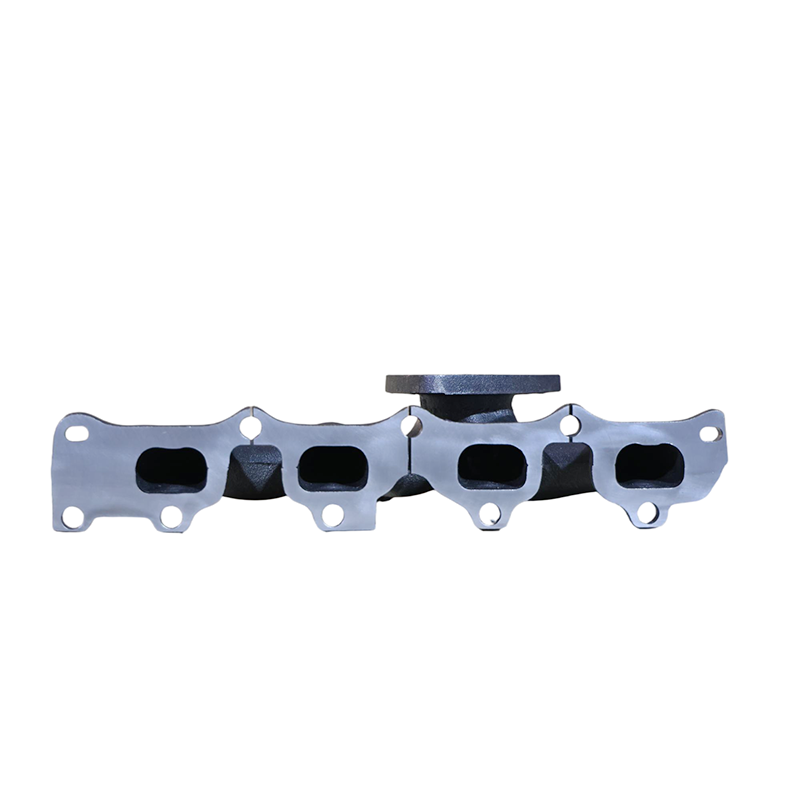
The standard cast manifold features a "log" style design. Manufacturers pour molten metal into a mold to create a single, thick-walled piece. This approach dominates mass-production OEMs and industrial engine manufacturing. It offers a highly budget-conscious replacement option for consumer vehicles.
Cast manifolds are incredibly durable. Their thick walls retain heat exceptionally well. This heat retention accelerates catalytic converter warm-up. However, the log shape forces exhaust pulses to collide. This turbulence limits high-RPM flow efficiency. Cast designs prioritize longevity and packaging constraints over maximum horsepower.
Tubular exhaust manifolds dominate the high-performance aftermarket and custom fabrication sectors. Builders weld individual metal tubes to a central flange. These tubes can feature equal or unequal lengths. Equal-length primary tubes time the exhaust pulses perfectly. This optimizes exhaust scavenging. Scavenging actively pulls spent gases from the combustion chamber.
Headers are lightweight and flow incredibly well at high RPMs. However, they introduce distinct engineering trade-offs. The thin tubular walls radiate more heat into the engine bay. They also carry a much higher risk of weld failure due to vibration. Furthermore, fabricating tubular headers involves high labor inputs. This drives up the final manufacturing cost significantly.
Feature | Cast Manifold (Log Style) | Tubular Header |
|---|---|---|
Target Market | OEMs, Industrial, Daily Drivers | Motorsports, Aftermarket, Custom Builds |
Volumetric Efficiency | Moderate (turbulent flow) | Excellent (optimized scavenging) |
Durability | Extremely High | Moderate (prone to weld fatigue) |
Heat Retention | Excellent (fast catalyst heating) | Poor (high engine bay radiation) |
Production Cost | Low at high volume | High (labor-intensive fabrication) |
Material selection defines the operational lifespan of the exhaust system. Engineers must solve a complex thermal equation. The material must survive brutal heating and cooling cycles. It must resist corrosive gases. We evaluate these materials based on their ability to translate features into reliable outcomes.
Cast iron remains the undisputed industry standard for passenger vehicles. It provides phenomenal thermal retention. This ensures fast catalyst warm-up to meet EPA regulations. Nodular, or ductile, iron includes graphite nodules. These nodules increase flexibility and prevent catastrophic cracking. Iron manifolds are undeniably heavy. However, they are highly cost-effective. They resist warping under immense structural loads.
Stainless steel offers distinct advantages for tubular designs. Grade 409 stainless steel provides a lower cost entry point. It handles thermal resistance well. The surface will develop a rust layer over time. Yet, it rarely corrodes entirely through. OEMs frequently use 409 as an upgrade over basic steel.
Grades 304 and 316 are austenitic stainless steels. They deliver superior corrosion resistance. Builders love them for their polished aesthetic appeal. Unfortunately, austenitic steels expand significantly when heated. This high thermal expansion coefficient creates a major risk. They often suffer from thermal expansion cracking under extreme, sustained heat.
Top-tier motorsports and aerospace applications demand exotic alloys. Titanium offers an unmatched strength-to-weight ratio. It saves vital pounds on race cars. Inconel is a nickel-chromium superalloy. It delivers absolutely extreme heat tolerance. Formula 1 teams rely heavily on Inconel. However, these materials are notoriously difficult to machine. Their prohibitive material and machining costs keep them out of standard consumer vehicles.
Avoid choosing materials based purely on weight savings. Instead, evaluate them based on your specific Exhaust Gas Temperatures (EGTs). Consider your lifecycle durability targets. A daily-driven truck requires the heavy stability of nodular iron. A track-dedicated sports car benefits from the rapid scavenging of 304 stainless steel. Match the alloy to the exact thermal cycle profile.
Translating a digital CAD file into a physical component requires navigating strict tooling constraints. The chosen manufacturing process dictates your unit economics. It also determines the internal surface quality of the final part.
Mass producers rely on sand casting and investment casting. These methods require high initial tooling and pattern costs. You must design and machine precise molds. However, once tooling is complete, casting offers the lowest cost per unit at scale. Success hinges on precise core design. The inner sand core must remain perfectly stable during the pour. This maintains internal wall smoothness and prevents flow restrictions.
Tubular headers utilize CNC mandrel bending. A machine pulls a solid mandrel through the pipe during bending. This prevents the tube from collapsing or crushing. It maintains a consistent inner diameter for perfect airflow. This process presents a lower barrier to entry for tooling. You do not need expensive cast molds.
However, fabrication carries higher labor and per-unit costs. Technicians must precision-cut and assemble the tubes. The process requires highly skilled TIG or MIG welding. Poor welds create weak joints. These joints quickly suffer fatigue and crack under engine vibration.
Additive manufacturing is rapidly emerging in the automotive sector. Engineers use 3D printing for rapid prototyping. It allows teams to test physical fitment before committing to expensive casting molds. Moreover, 3D printing manufactures highly complex, low-volume geometries. Hypercar manufacturers and Formula 1 teams print Inconel parts. They create internal flow paths that are physically impossible to cast or bend.
Even the best digital designs face implementation realities. Exhaust components operate in a brutal environment. Quality control prevents catastrophic field failures. We must monitor several primary failure points rigorously.
The manifold flange mates directly against the aluminum engine cylinder head. Metal moves unpredictably when welded or cast. This creates thermal warping. A warped flange will not seal properly. It causes dangerous exhaust leaks. Manufacturers must surface grind flanges perfectly flat post-welding or post-casting. This ensures a leak-proof seal under clamping load.
Fabricated manifolds rely entirely on their welds. Technicians must assess weld penetration deeply. They must use proper shielding gas coverage to prevent oxidation. Contaminated welds become brittle. High engine vibration easily cracks these brittle joints. Quality assurance teams routinely inspect these critical junctions.
Poor geometry restricts power. Engineers utilize CFD (Computational Fluid Dynamics) analysis extensively during the design phase. CFD software simulates exhaust gas velocity and temperature. It helps teams identify flow dead zones. It spots unwanted turbulence. It also reveals unequal cylinder backpressure. Fixing these issues digitally saves countless hours of physical testing.
Designers cannot ignore legal and functional placement requirements. The design must accommodate specific O2 sensor placements. Sensors placed incorrectly provide bad data to the engine control unit. Furthermore, the design must meet EPA and CARB spatial requirements. There must be enough room for proper emissions equipment packaging.
Perform primary 3D CMM (Coordinate Measuring Machine) laser scanning to verify dimensional accuracy.
Execute ultrasonic thickness testing on cast walls to detect internal voids.
Conduct pressure decay leak testing to ensure complete structural sealing.
Apply post-weld heat treatment to relieve internal material stresses.
Selecting a supplier dictates the success of your production run. Procurement managers must look beyond standard pricing quotes. You need a partner capable of executing strict automotive tolerances consistently.
First, evaluate their core capability alignment. Does the supplier specialize in high-volume iron casting? Or do they focus on precision low-volume stainless fabrication? A foundry mastering heavy industrial iron often struggles with thin-wall stainless TIG welding. Match your specific design architecture to their proven factory floor strengths.
Do not accept verbal quality promises. Look for verified ISO 9001 compliance. Better yet, demand IATF 16949 certification. IATF 16949 indicates rigorous automotive quality management systems. It proves the supplier uses standardized defect prevention protocols. It shows they understand automotive supply chain reduction variations.
A reliable partner verifies their own work. Check their ability to perform non-destructive testing (NDT) in-house. They should utilize X-ray or ultrasonic equipment to find hidden casting porosity. They must offer pressure decay leak testing. They also need 3D CMM inspection tools to guarantee flange flatness before shipping.
Finally, assess their supply chain stability. You require transparency in their raw material sourcing. Can they prove the origin of their stainless steel or nodular iron? Assess their capacity to scale. A good partner seamlessly transitions from initial prototype runs to full mass production. They should do this without relying on risky secondary outsourcing.
Specifying a high-quality exhaust component requires navigating strict engineering trade-offs. You must balance maximum flow efficiency against material durability under brutal thermal stress. You also have to align these technical needs with realistic manufacturing economics. Cast iron offers unbeatable longevity and cost-efficiency for mass production. Conversely, fabricated tubular designs unlock massive volumetric performance for specialized applications.
To move forward successfully, compile your final CAD models. Clearly define your operating temperature targets and total volume forecasts. Take these metrics and initiate a formal technical review with a verified manufacturing partner. Properly vetting their casting, welding, and quality control capabilities guarantees a reliable, leak-free product that performs exactly as designed.
A: An exhaust manifold typically refers to a heavy, cast-iron log-style component. It features thick walls designed for durability, heat retention, and mass-production efficiency. A header is a fabricated tubular design made from welded steel or stainless steel pipes. Headers prioritize exhaust gas scavenging and high-RPM power over long-term durability and budget.
A: Cast iron manifolds crack due to severe thermal cycling. They rapidly heat up to extreme temperatures under load and cool down quickly when the engine shuts off. Over time, this constant expansion and contraction causes metal fatigue. Internal stresses build up, eventually leading to structural fissures.
A: It depends on your performance goals. If you need better exhaust flow, lighter weight, and superior corrosion resistance, stainless steel is excellent. However, if you are simply replacing a broken part on a daily commuter, the higher cost and risk of thermal expansion cracking might not justify the upgrade.
A: Design directly impacts exhaust gas velocity and heat retention. Turbos rely on hot, fast-moving gases to spool the turbine wheel. A manifold that minimizes internal volume while retaining high heat energy drives the turbine much faster. This drastically reduces turbo lag and improves overall engine responsiveness.


